
-
News
Torr Metals Intersects Extensive Hydrothermal Brecciation and Multi-Stage Veining at Bertha North, Advancing Cu-Au Porphyry Model
July 22, 2026
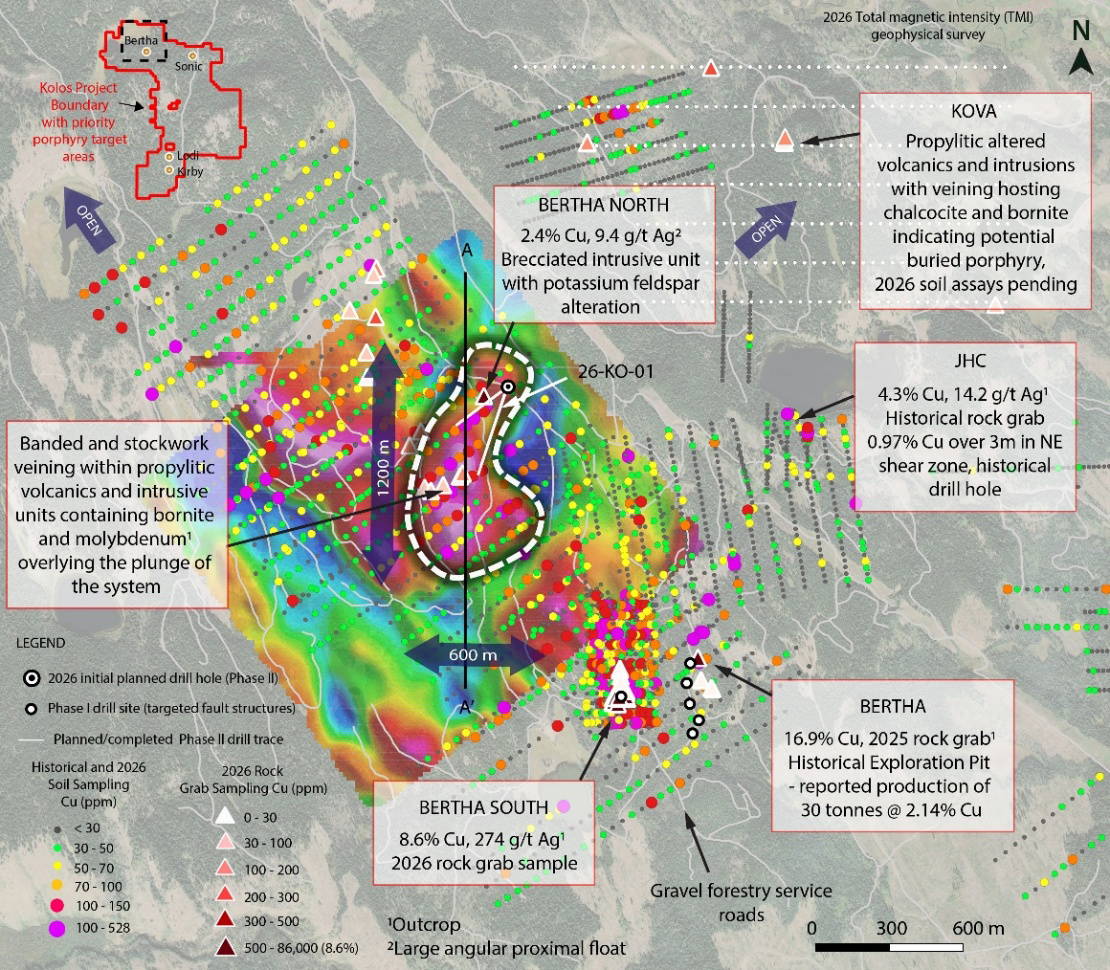
Edmonton, Alberta, AB, July 22, 2026 – Torr Metals Inc. (“Torr” or the "Company") (TSX-V: TMET.V) is pleased to provide a geological update from the Company's fully funded Phase II drill program of up to 6,000 metres (m) at the Bertha North target, part of the 332 km² Kolos Copper-Gold Project in southern British Columbia.
The first drill hole (26-KO-01) has confirmed an extensive long-lived hydrothermal system down to approximately 563 metres depth, with a highly prospective interval of approximately 142 metres core length (Figure 1) from 318.5 m to 460.9 m characterized by multiple generations of quartz-carbonate veining, crackle to hydrothermal brecciation, and progressively increasing sericitic alteration intensity within a favourable volcanic host sequence cross-cut by felsic intrusions (Figure 1, Figure 2). These observations represent an important step in refining the Company's evolving geological model, which is targeting the intrusive source responsible for the large hydrothermal native copper system discovered during Phase I drilling in late 2025.
Highlights:
- First drill hole confirms a long-lived and evolving copper (Cu) – gold (Au) hydrothermal system, recording early high-temperature magnetite ± epidote alteration overprinted by repeated brittle fracturing, multiple pulses of quartz-carbonate veining, open-space (toothcomb) quartz growth, and later-stage alteration and oxidation, indicative of sustained mineralized fluid flow through structurally prepared corridor (Figure 1, Figure 2).
- Hydrothermal alteration and structural preparation intensify toward the interpreted porphyry feeder zone, transitioning from oxidized silicified volcanic rocks into increasingly epidote- and sericite-altered intervals characterized by stronger veining, brecciation, and repeated structural reactivation (Figure 2).
- Systematic geological logging and pXRF screening identify successive hydrothermal events, with the most intensely altered and structurally prepared intervals corresponding to distinct multi-element geochemical responses. Hematitic alteration persists to the end of the hole, approximately 400 m vertically below surface, largely obscuring primary sulphide textures. Where local fresh exposures occur chalcopyrite and chalcocite are observed, supporting the interpretation of a long-lived copper-bearing hydrothermal system that is interpreted to represent a major structurally focused feeder zone, or "main plumbing," within a porphyry copper-gold system, providing a key vector for ongoing drill targeting.
- Magnetite-bearing veinlets and hydrothermal brecciation confirm early high-temperature fluid activity, while brecciated volcanic host rocks demonstrate sustained permeability and repeated fluid circulation, consistent with long-lived copper Cu-Au porphyry systems.
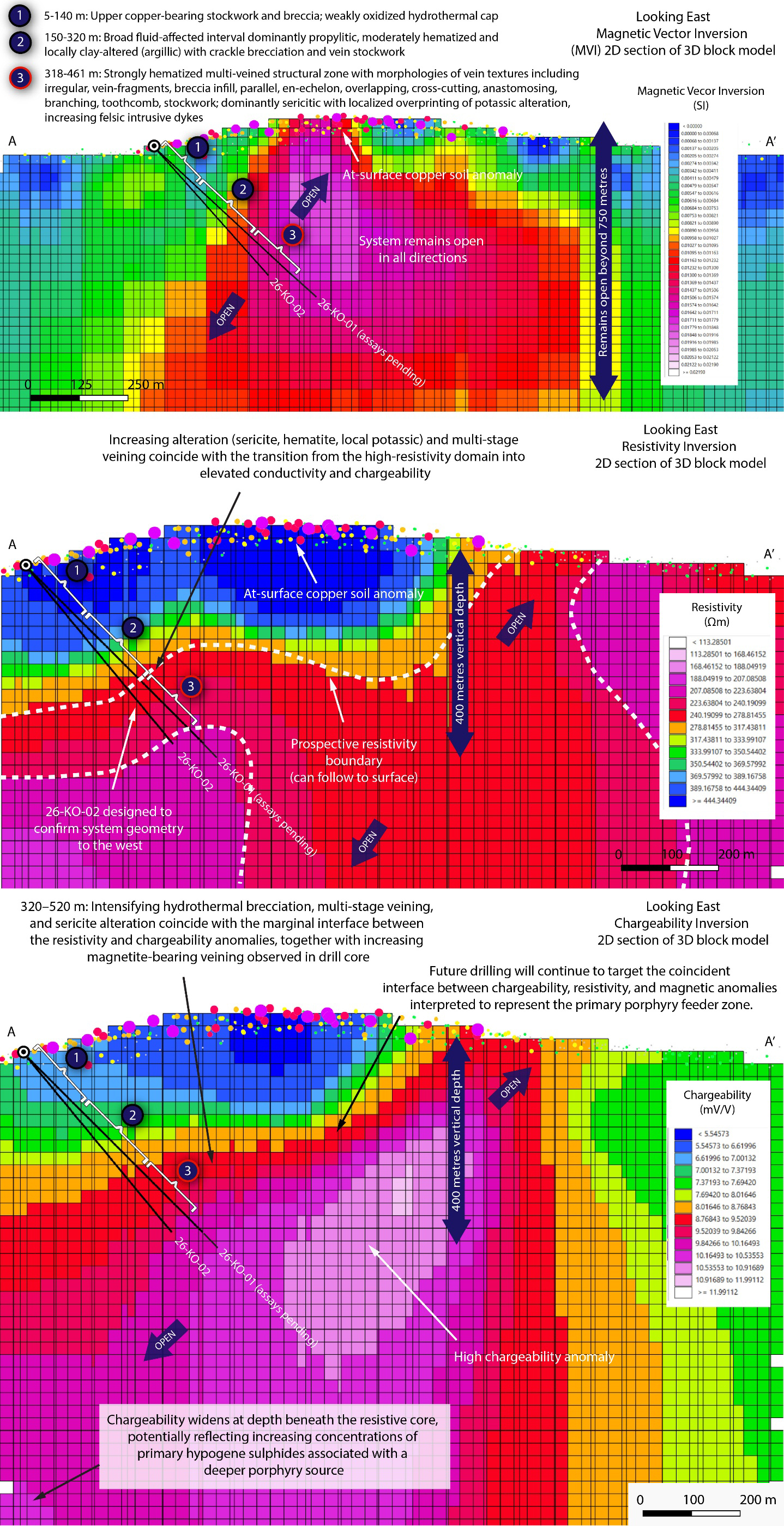
- Observations continue to strengthen the Company's intrusive source model, with the strongest veining, alteration, brecciation, and magnetite development occurring along the transition between the magnetic-resistive domain and the adjacent chargeability anomaly, refining targeting toward the interpreted intrusive source.
"One of the greatest advantages of drilling a completely untested porphyry target is that every metre significantly de-risks the geological model while advancing the potential for a brand new discovery," stated Malcolm Dorsey, President and CEO. "While laboratory assays remain pending, the geology has been extremely encouraging. The progressive increase in hydrothermal brecciation, multi-stage veining, alteration, felsic intrusions, and structural preparation at the transition between the resistive and chargeable geophysical domains is exactly what we expected to encounter within a major hydrothermal feeder corridor. Hole 26-KO-02 was designed as a follow-up to confirm the geometry of this interpreted feeder system, and we now believe it represents a direct connection to the porphyry intrusion driving the broader hydrothermal system. Subsequent drilling will also directly target the adjacent chargeability anomaly, which we believe may represent the intrusive source driving the hydrothermal system. We look forward to updating shareholders as drilling progresses and laboratory assays become available."
Figure 1. Representative select drill core with depths listed from within the 320 to 520 m hydrothermal corridor in hole 26-KO-01, illustrating crackle to hydrothermal brecciation overprinted by multiple generations of quartz-carbonate veining with epidote ± sericite alteration. Repeated brittle fracturing, open-space (toothcomb) quartz growth, and magnetite-bearing veinlets record successive hydrothermal fluid events and sustained fluid flow. Note that pervasive hematite alteration overprints earlier hydrothermal mineral assemblages and may obscure primary sulphide textures, making laboratory assays and petrographic analysis key for evaluating the hydrothermal system.
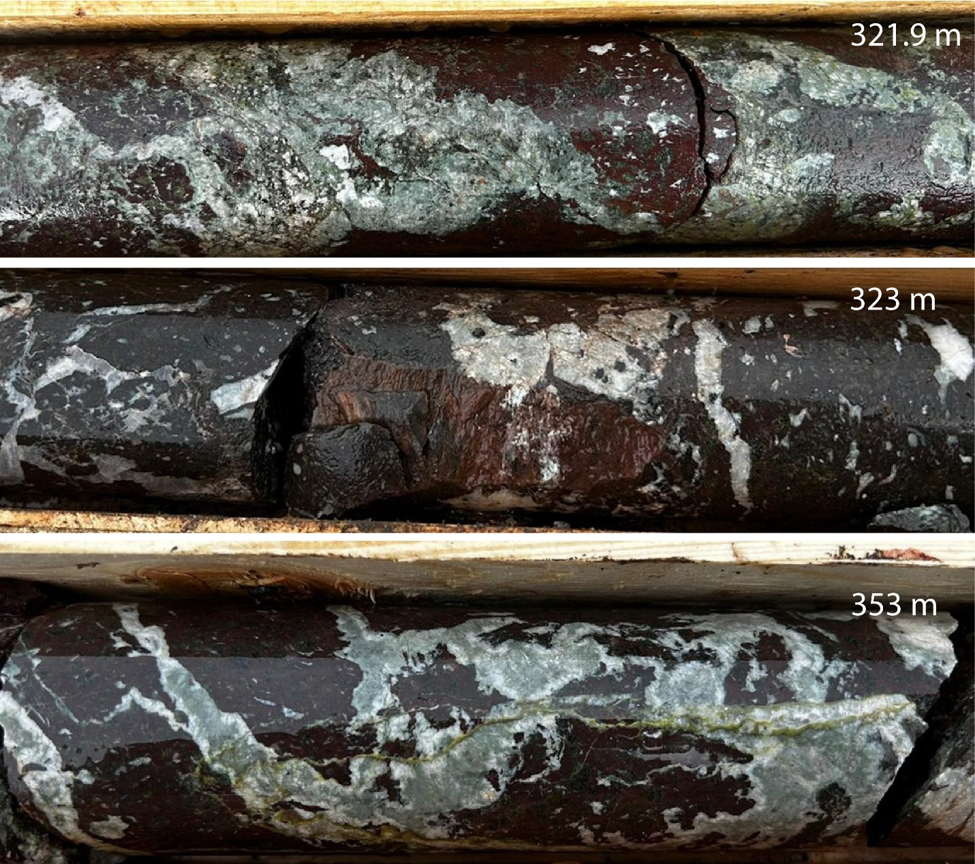
Figure 2. Magnetic vector inversion (MVI), resistivity, and chargeability 2D cross-sections across Bertha North showing strong zonation into a highly prospective geophysical interface where hydrothermal brecciation, multi-stage veining, magnetite veining, and repeated structural reactivation are concentrated. Note that drill site locations are based on existing road networks to minimize disturbance
Geological Discussion
Hole 26-KO-01 was designed to test both a coincident magnetic-resistive geophysical anomaly together with a bounding induced polarization (IP) chargeability anomaly identified during the Company's 2026 geophysical program (Figure 2).
The upper portion of the hole intersected oxidized, silicified volcanic rocks containing localized felsic to felsic dykes before transitioning into an extensive sequence of fragmental to amygdaloidal volcanic rocks displaying progressively stronger hydrothermal textures (Figure 2).
Toward the interpreted boundary between the magnetic-resistive domain and the bounding chargeability anomaly, drill core exhibits (Figure 1):
- multiple generations of quartz-carbonate vein networks;
- crackle to hydrothermal brecciation;
- pervasive epidote ± sericite alteration;
- localized magnetite veinlets and fracture infill;
- repeated brittle reactivation and fluid pathways.
The Company interprets the observed succession of hydrothermal textures; including repeated quartz veining, hydrothermal brecciation, evolving epidote-to-sericite alteration, localized magnetite veining, and multiple episodes of brittle reactivation as being consistent with an increasingly focused hydrothermal conduit, supporting interpretation as a structurally controlled feeder zone with features consistent with a large porphyry copper-gold system.
Qualified Person
The technical content of this news release has been reviewed and approved by Michael Dufresne, M.Sc., P.Geol., P.Geo., a consultant to the Company who is a non independent qualified person defined under National Instrument 43-101.
About Torr Metals
Torr Metals, headquartered in Edmonton, AB, is focused on unlocking new copper and gold discovery potential within proven, highly accessible mining districts across Canada, areas with both established infrastructure and a growing need for near-term feed. Torr's 100%-owned, district-scale assets are strategically located for cost-effective, year-round exploration and development. The 275 km² Kolos Copper-Gold Project and strategically option 57 km2 Bertha Property, situated in southern British Columbia's prolific Quesnel Terrane, lies just 30 km southeast of the Highland Valley Copper Mine, Canada's largest open-pit copper operation, and 40 km south of the city of Kamloops directly along Highway 5. In northern Ontario, the 261 km² Filion Gold Project covers a virtually unexplored greenstone belt with high-grade orogenic gold potential. It sits just off the Trans-Canada Highway 11, approximately 42 km from Kapuskasing and 202 km by road from the Timmins mining camp, home to world-class operations like Hollinger, McIntyre, and Dome. To learn more, visit Torr Metals online or view company documents via SEDAR+ at www.sedarplus.com.
On behalf of the Board of Directors
Torr Metals Inc."Malcolm Dorsey"
Malcolm Dorsey
President, CEO and DirectorFor further information:
Malcolm Dorsey
Telephone: 236-982-4300
Email: malcolmd@torrmetals.comNeither the TSX Venture Exchange nor its Regulation Services Provider (as that term is defined in the policies of the TSX Venture Exchange) accepts responsibility for the adequacy or accuracy of this press release.
Cautionary Statement Regarding Forward-Looking Information
This press release contains "forward-looking information" within the meaning of applicable Canadian securities legislation. Forward-looking information includes, without limitation, statements regarding the use of proceeds from the Company's recently completed financings, and the future plans or prospects of the Company. Generally, forward-looking information can be identified by the use of forward-looking terminology such as "plans", "expects" or "does not expect", "is expected", "budget", "scheduled", "estimates", "forecasts", "intends", "anticipates" or "does not anticipate", or "believes", or variations of such words and phrases or state that certain actions, events or results "may", "could", "would", "might" or "will be taken", "occur" or "be achieved". Forward-looking statements are necessarily based upon a number of assumptions that, while considered reasonable by management, are inherently subject to business, market and economic risks, uncertainties and contingencies that may cause actual results, performance or achievements to be materially different from those expressed or implied by forward-looking statements. Although the Company has attempted to identify important factors that could cause actual results to differ materially from those contained in forward-looking information, there may be other factors that cause results not to be as anticipated, estimated or intended. There can be no assurance that such information will prove to be accurate, as actual results and future events could differ materially from those anticipated in such statements. Accordingly, readers should not place undue reliance on forward-looking information. Other factors which could materially affect such forward-looking information are described in the risk factors in the Company's most recent annual management's discussion and analysis which is available on the Company's profile on SEDAR at www.sedar.com. The Company does not undertake to update any forward-looking information, except in accordance with applicable securities laws.