Torr Metals Intersects Copper Sulphides and Potassic Alteration in Emerging Cu-Au Porphyry System at Bertha North
Aug 18, 2026 · TSXV: TMET
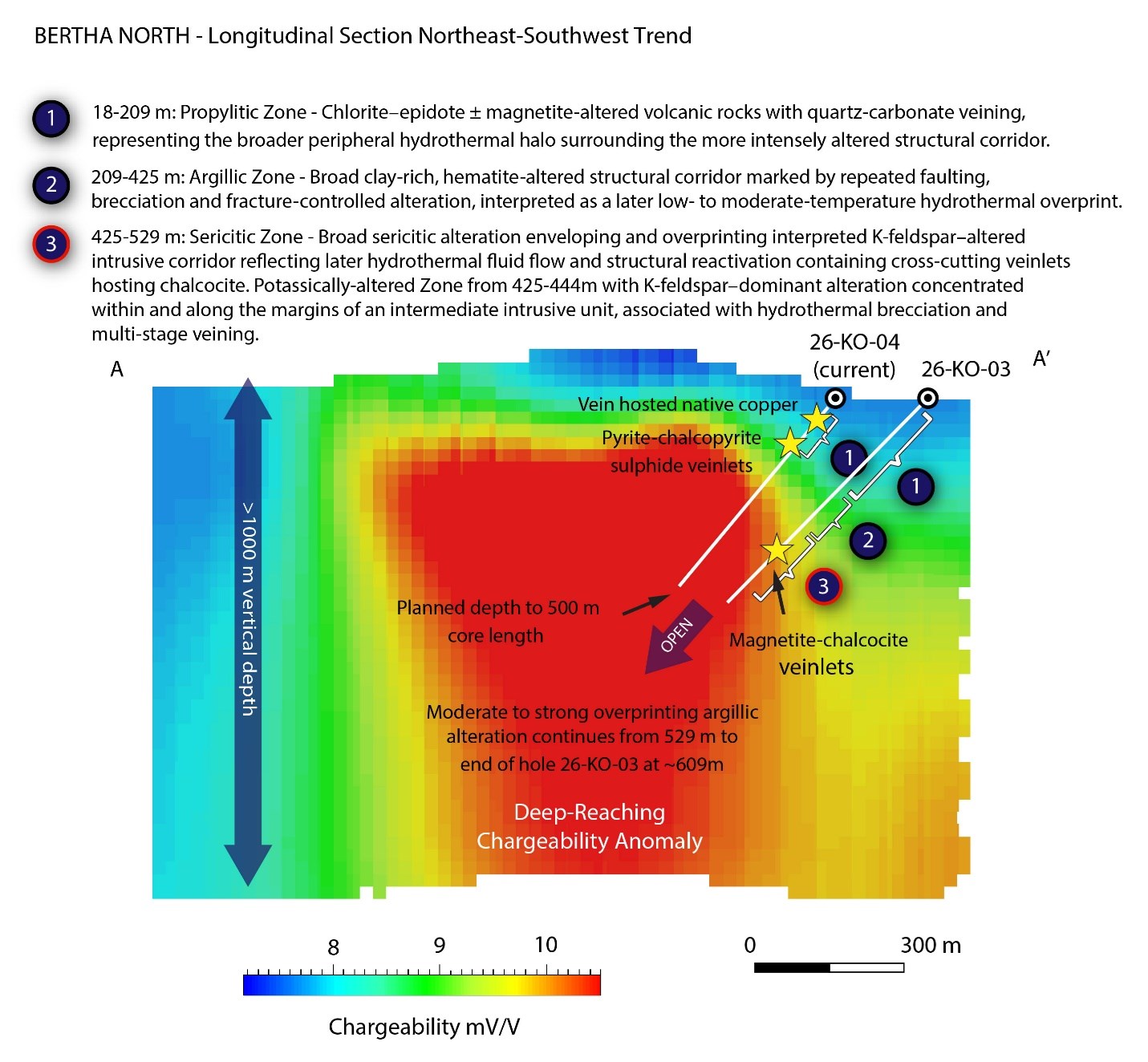
Edmonton, Alberta--(Newsfile Corp. - August 18, 2026) - Torr Metals Inc. (TSXV: TMET) ("Torr" or the "Company") is pleased to provide an update from its fully funded Phase II drill program at Bertha North, where 1,733 metres (m) of drilling has now been completed within a planned fully-funded program of up to 6,000 m. The first four holes have confirmed a large porphyry-style hydrothermal system, with native copper, chalcopyrite and chalcocite observed in cross-cutting veinlets (Figure 1). Significantly, in hole 26-KO-03 drilling also progressed into an interpreted potassium (K)-feldspar-dominant potassic-altered intrusive unit from approximately 425 to 444 m, within a broader ~104 m sericitic alteration envelope. Copper sulphides appear concentrated along the margins of the potassic-altered intrusive in 26-KO-03, where hydrothermal brecciation and multi-stage veining are also stronger (Figure 2, Figure 3).
Potassic alteration is a key feature of porphyry systems, reflecting hotter and more proximal hydrothermal fluids. Its presence may indicate that drilling is approaching the magmatic-hydrothermal centre of the system, where higher concentrations of copper sulphides may be encountered in certain locations. At Bertha North, this intrusive corridor lies directly within and along the margins of a large chargeability anomaly that strengthens, broadens and remains open at depth, where it is coincident with increased resistivity, providing the Company with its strongest vector to date toward a potential porphyry core.
Hole 26-KO-04 is currently at approximately 180 m and is drilling more directly toward the stronger portion of the chargeability anomaly. Although still within the interpreted argillic zone, the hole has already intersected native copper in near-surface veins for the first time in the Phase II program, together with pyrite-chalcopyrite veinlets near the outer margin of the chargeability anomaly. These early observations add further evidence of copper-bearing hydrothermal fluid flow as drilling continues deeper into the target (Figure 3).
Highlights
- Copper Sulphides Confirmed in Altered Corridor: Copper sulphides, including chalcocite and chalcopyrite in cross-cutting and stockwork veinlets, have been observed within the intensely altered corridors in the first four holes, together with native copper in 26-KO-04, providing direct evidence of copper-bearing hydrothermal fluids within the emerging porphyry system (Figure 1).
- Regional Exploration Analogue: As a regional exploration analogue, the New Afton Cu-Au porphyry deposit in British Columbia hosts strong K-feldspar-dominant potassic alteration within the Cherry Creek monzonite, an intermediate intrusive phase interpreted as the source of heat and metals for the deposit¹. Significant primary Cu-Au mineralization is closely associated with biotite-dominant potassic alteration along and adjacent to intrusive margins, providing an important targeting analogue for Bertha North. Ongoing drilling will test the continuation and margins of the interpreted potassically-altered intrusive and the stronger chargeability response for additional intrusive phases and potential sulphide development (Figure 2, Figure 3).
- Hole 26-KO-04 Adds Additional Early Copper Indicators: Hole 4 (26-KO-04) is currently at approximately 180 m core length and, while still within the interpreted argillic zone, has intersected native copper in near-surface veins, for the first time in the Phase II program, as well as pyrite-chalcopyrite veinlets near the outer margin of the chargeability anomaly. The hole is continuing toward the stronger and broader portion of the chargeability response (Figure 3).
"With only three holes completed, we believe we are just beginning to unlock the scale and copper-gold potential of Bertha North," stated Malcolm Dorsey, President and CEO. "What is particularly exciting is that the geological vectors are strengthening as we advance, with copper sulphides, increasing stockwork veining and an intrusive phase affected by hotter, more proximal potassic alteration all pointing us toward the potential centre of a large hydrothermal-magmatic system. Hole 4 is already providing further strong encouragement, with native copper and pyrite-chalcopyrite veinlets encountered while still near the outer margin of the chargeability anomaly. With assays pending, a large and strengthening geophysical target still ahead of the drilling, and multiple targets yet to be tested, we believe Bertha North is at a very early stage with significant discovery potential still in front of us."
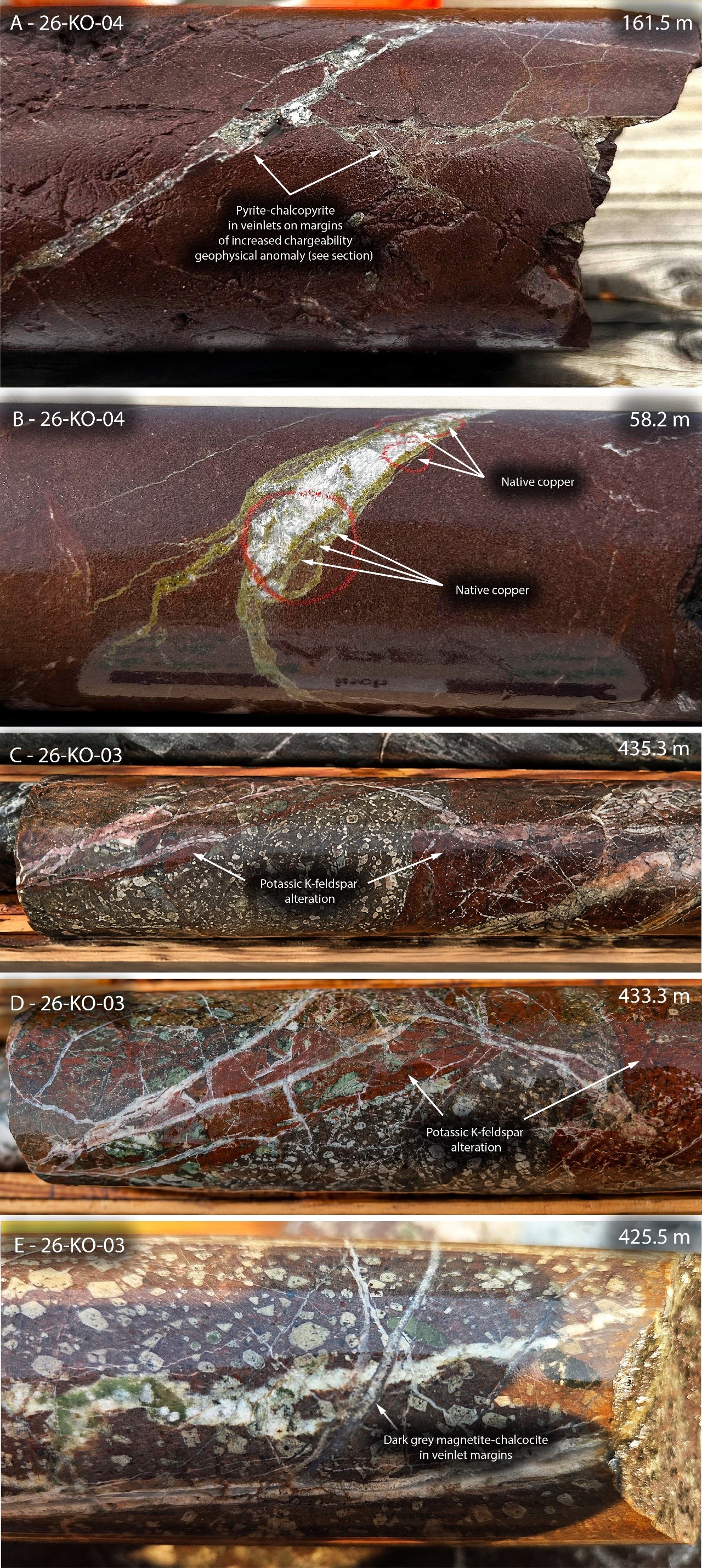
Figure 1. Representative red (hematized) drill core showing pyrite-chalcopyrite and native copper mineralization in drill hole 26-KO-04 (A-B), intrusive rocks affected by intense reddish interpreted K-feldspar alteration (B-C), hydrothermal brecciation and multiple generations of cross-cutting veinlets and stockwork within a broader overprinting sericitic alteration corridor (D). Dark grey material (D) interpreted as magnetite with chalcocite occurring in veinlet margins. Alteration and mineral identification remain subject to petrographic, geochemical and laboratory confirmation.
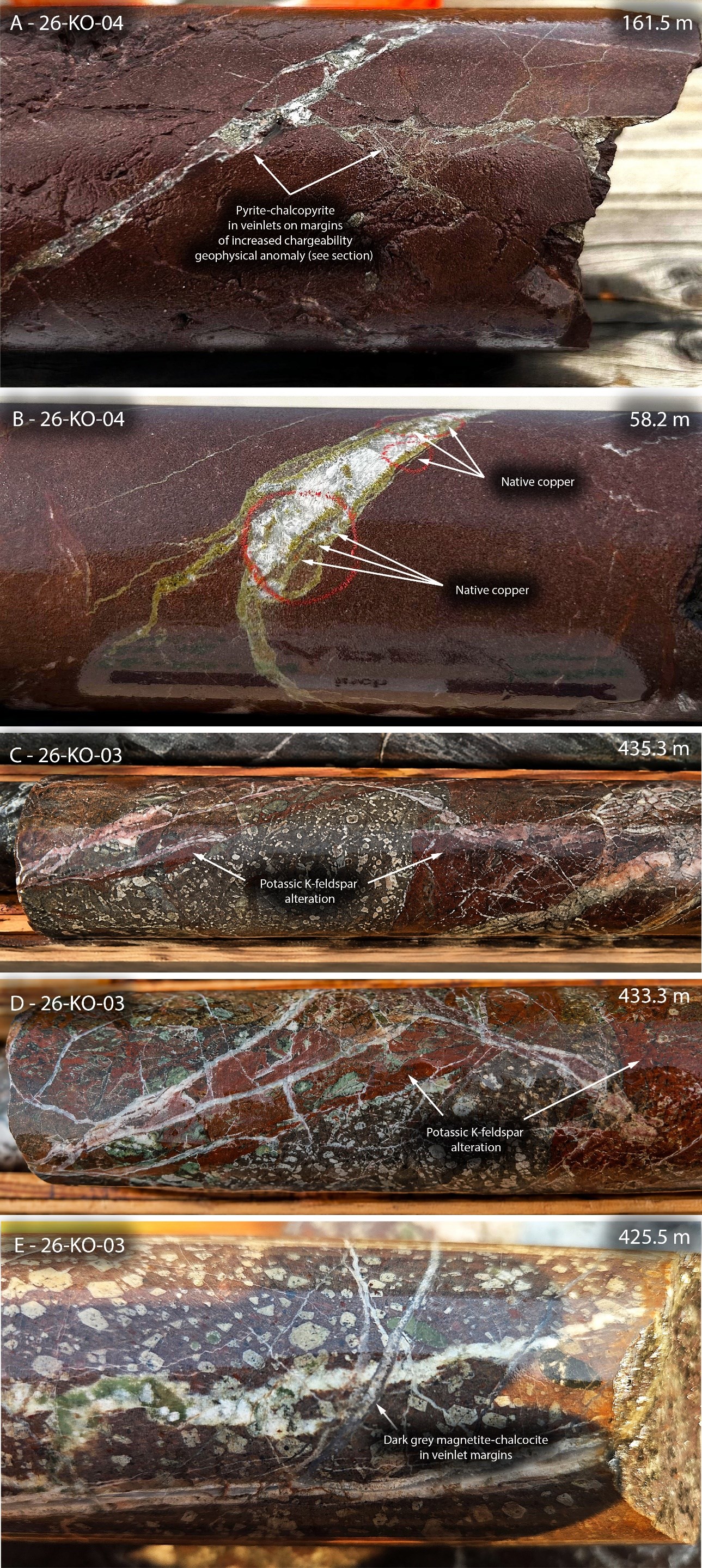
Figure 2. Plan view of the Bertha North target showing Phase II drill holes relative to 2026 IP chargeability at approximately 200 m depth, surface copper geochemistry and interpreted northwest- and northeast-trending structural corridors. Holes 26-KO-03 and 26-KO-04 test the interpreted northeast-trending interface toward the deeper chargeability anomaly.
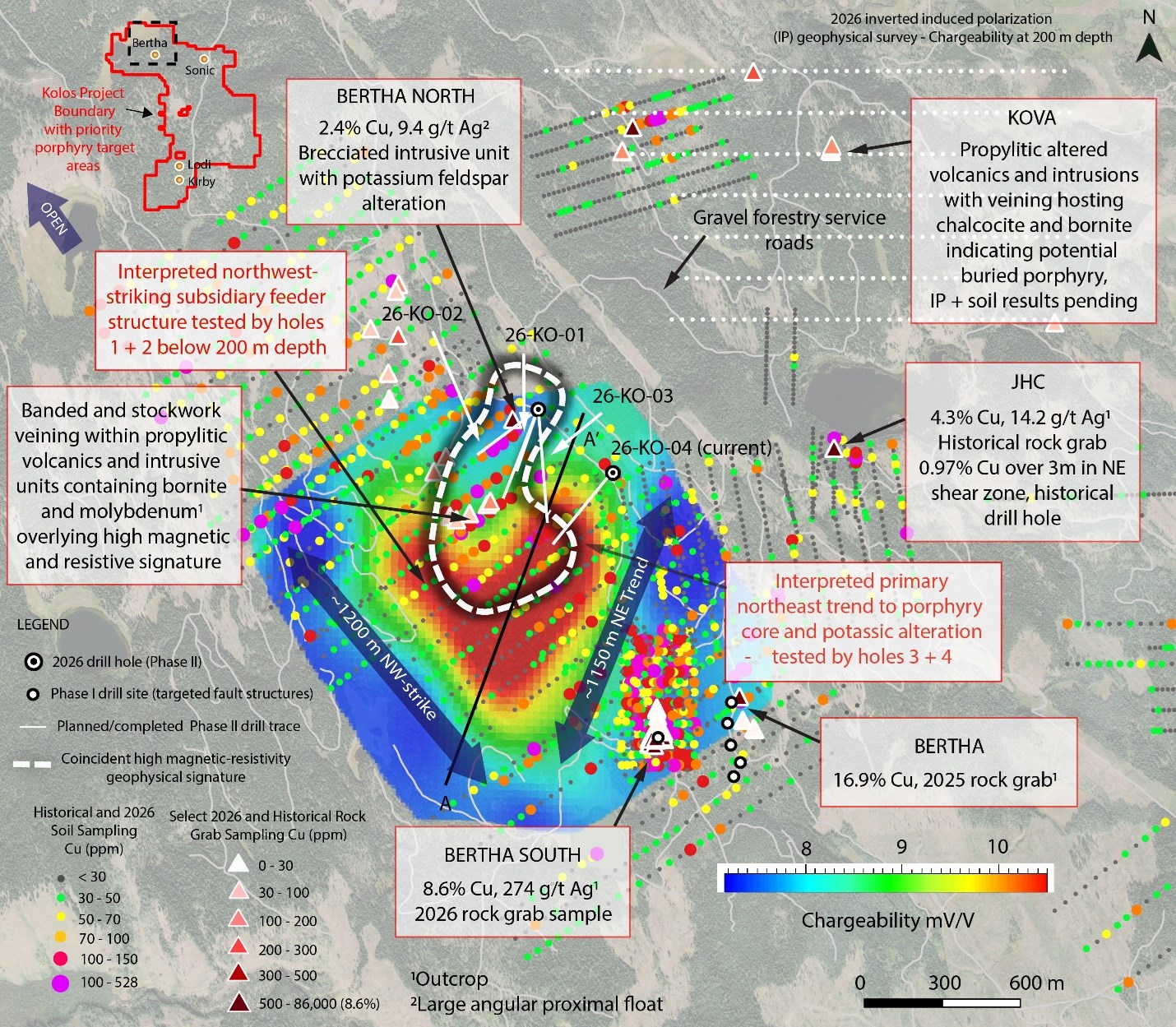
Figure 3. Northeast-southwest longitudinal IP chargeability section through holes 26-KO-03 and 26-KO-04 illustrating interpreted alteration zonation in 26-KO-03 and current 26-KO-04 together with the relationship of the drill holes to the deep-reaching chargeability anomaly. Hole 26-KO-04 is currently advancing southwestward toward the stronger portion of the anomaly.
Hole 26-KO-03 Defines Increasingly Proximal Alteration and Copper-Mineralization Vector
Hole 26-KO-03 represents the first direct drill test of the interpreted northeast-trending interface between contrasting chargeability and resistivity signatures at Bertha North. Geological logging has identified a broad, vertically extensive and multiphase hydrothermal alteration system, with copper sulphides observed within the more intensely altered intrusive corridor (Figure 3):
- 18–209 m – Propylitic Zone: Chlorite-epidote ± magnetite-altered volcanic rocks with quartz-carbonate veining, interpreted as part of the broader peripheral hydrothermal halo.
- 209–425 m – Argillic Zone: Broad clay- and hematite-rich alteration associated with repeated faulting, brecciation and fracture-controlled hydrothermal alteration, marking a transition toward the more intensely altered intrusive corridor at depth.
- 425–529 m – Sericitic and Potassic-Altered Intrusive Corridor: Broad sericitization envelops and locally overprints an interpreted K-feldspar-dominant potassic-altered intermediate intrusive and Nicola volcanics from approximately 425–444 m. This interval is characterized by hydrothermal brecciation, multiple generations of cross-cutting veins and copper mineralization including chalcocite observed in veinlets. Importantly, observed copper sulphides appear to be preferentially concentrated along and adjacent to the margins of the potassic-altered intrusive phases, providing an additional mineralization vector for ongoing drilling.
Moderate to strong argillic alteration continues from approximately 529 m to the end of hole at approximately 609 m, demonstrating the considerable vertical extent and multiphase character of the hydrothermal system. The intensity of alteration, together with repeated faulting, brecciation and locally challenging ground conditions, contributed to slower-than-anticipated drilling progress through portions of the hole and program to-date. Within 26-KO-03 the coincidence of potassic alteration, intrusive contacts, hydrothermal brecciation, multi-stage veining and copper sulphides along the margin of a deep-reaching chargeability anomaly provides the Company with an increasingly focused vector for follow-up drilling toward the interpreted core of the system.
Significance of the Potassic-Altered Intrusive
The Company considers the recognition of interpreted K-feldspar-dominant alteration concentrated within an intermediate intrusive to represent an important advancement in the Bertha North geological model. In porphyry systems, potassic alteration forms from comparatively hot hydrothermal fluids and commonly occupies a more proximal position within the alteration architecture. In practical exploration terms, "proximal" means closer to the magmatic-hydrothermal source or centre that supplied the heat and metal-bearing fluids to the surrounding system. Its recognition therefore provides a vector for focusing subsequent drilling, particularly when combined with intrusive rocks, hydrothermal brecciation, multi-stage veining and observed copper sulphides.
This relationship provides an important targeting concept for Bertha North. As at New Afton Torr does not interpret the K-feldspar-altered intrusive itself as necessarily representing the principal mineralized target. Rather, its recognition provides a vector for testing the intrusive continuation, contacts and surrounding wall rocks through the stronger chargeability response, where the Company will be watching for potentially increasing sulphide abundance, hydrothermal brecciation and development of more proximal alteration assemblages.
The apparent overprinting relationships in 26-KO-03 may also be significant. Earlier interpreted potassic alteration occurs within a broader sericitic corridor and extensive structurally controlled argillic alteration, recording multiple hydrothermal events and repeated structural reactivation. Petrographic analysis, whole-rock geochemistry and laboratory assays will be used to confirm the alteration mineralogy and determine the significance of observed copper mineralization.
Hole 26-KO-04 Tests Farther Into Strengthening Chargeability Target
Integration of drilling with the 2026 IP inversion indicates that the northeast-trending hydrothermal corridor occurs along the margin of a large chargeability response that strengthens and broadens southwestward and remains open at depth (Figure 3).
Hole 26-KO-04 is currently at approximately 180 m core length and is drilling more directly toward the stronger portion of the anomaly to test the continuation of the intrusive-hydrothermal architecture identified in 26-KO-03. Although currently within the interpreted argillic alteration zone, the hole has intersected native copper in near-surface veins for the first time in the Phase II program, as well as pyrite-chalcopyrite veinlets near the outer margin of the chargeability anomaly. The Company considers these observations encouraging evidence of hot copper-bearing and potentially proximal hydrothermal fluid flow.
Rather than relying on chargeability magnitude alone, Torr considers the convergence of intrusive rocks, interpreted potassic alteration, sericitization, hydrothermal brecciation, multi-stage veining and strengthening chargeability and resistivity to represent a highly compelling exploration vector toward a potential mineralized porphyry centre at Bertha North.
Laboratory assays from the first three drill holes remain pending, and petrographic and geochemical work will be required to confirm alteration mineralogy and the significance of observed mineralization.
1Information and comparisons disclosed on nearby properties is not necessarily indicative of precious or base metal endowment or assays on the Kolos Project. Roberts, T., Wade, D., Katchen, J., Nadeau-Benoit, V., Davis, M., & O'Hara, E. (2025). New Afton Operations, British Columbia, Canada: Technical Report Summary. Prepared for Coeur Mining, Inc. Effective date December 31, 2025, 192 p.
Quality Assurance and Control
The analytical work reported on herein was performed by ALS Global ("ALS"), Kamloops, Canada. ALS is an ISO-IEC 17025:2017 and ISO 9001:2015 accredited geoanalytical laboratory and is independent of Torr Metals Inc. and the QP. Drill core samples were subject to crushing at a minimum of 70% passing 2 mm, followed by pulverizing of a 250-gram split to 85% passing 75 microns. Base and precious metals were determined via four-acid digestion 48 element ICP-MS geochemistry and 30-gram gold fire assay.
Torr Metals Inc. follows industry standard procedures for the work carried out on the Kolos Project, with a quality assurance/quality control (QA/QC) program. Blank, duplicate, and standard samples were inserted into the sample sequence sent to the laboratory for analysis. Torr Metals Inc. detected no significant QA/QC issues during review of the data. Torr Metals Inc. is not aware of any drilling, sampling, recovery, or other factors that could materially affect the accuracy or reliability of the data referred to herein.
Qualified Person
The technical content of this news release has been reviewed and approved by Michael Dufresne, M.Sc., P.Geol., P.Geo., a consultant to the Company who is a non independent qualified person defined under National Instrument 43-101.
About Torr Metals
Torr Metals, headquartered in Edmonton, AB, is focused on unlocking new copper and gold discovery potential within proven, highly accessible mining districts across Canada, areas with both established infrastructure and a growing need for near-term feed. Torr's 100%-owned, district-scale assets are strategically located for cost-effective, year-round exploration and development. The 275 km² Kolos Copper-Gold Project and strategically option 57 km2 Bertha Property, situated in southern British Columbia's prolific Quesnel Terrane, lies just 30 km southeast of the Highland Valley Copper Mine, Canada's largest open-pit copper operation, and 40 km south of the city of Kamloops directly along Highway 5. In northern Ontario, the 261 km² Filion Gold Project covers a virtually unexplored greenstone belt with high-grade orogenic gold potential. It sits just off the Trans-Canada Highway 11, approximately 42 km from Kapuskasing and 202 km by road from the Timmins mining camp, home to world-class operations like Hollinger, McIntyre, and Dome. To learn more, visit Torr Metals online or view company documents via SEDAR+ at www.sedarplus.ca.
On behalf of the Board of Directors
Torr Metals Inc.
"Malcolm Dorsey"
Malcolm Dorsey
President, CEO and Director
For further information:
Malcolm Dorsey
Telephone: 236-982-4300
Email: malcolmd@torrmetals.com
Neither the TSX Venture Exchange nor its Regulation Services Provider (as that term is defined in the policies of the TSX Venture Exchange) accepts responsibility for the adequacy or accuracy of this press release.
Cautionary Statement Regarding Forward-Looking Information
This press release contains "forward-looking information" within the meaning of applicable Canadian securities legislation. Forward-looking information includes, without limitation, statements regarding the use of proceeds from the Company's recently completed financings, and the future plans or prospects of the Company. Generally, forward-looking information can be identified by the use of forward-looking terminology such as "plans", "expects" or "does not expect", "is expected", "budget", "scheduled", "estimates", "forecasts", "intends", "anticipates" or "does not anticipate", or "believes", or variations of such words and phrases or state that certain actions, events or results "may", "could", "would", "might" or "will be taken", "occur" or "be achieved". Forward-looking statements are necessarily based upon a number of assumptions that, while considered reasonable by management, are inherently subject to business, market and economic risks, uncertainties and contingencies that may cause actual results, performance or achievements to be materially different from those expressed or implied by forward-looking statements. Although the Company has attempted to identify important factors that could cause actual results to differ materially from those contained in forward-looking information, there may be other factors that cause results not to be as anticipated, estimated or intended. There can be no assurance that such information will prove to be accurate, as actual results and future events could differ materially from those anticipated in such statements. Accordingly, readers should not place undue reliance on forward-looking information. Other factors which could materially affect such forward-looking information are described in the risk factors in the Company's most recent annual management's discussion and analysis which is available on the Company's profile on SEDAR at www.sedarplus.ca. The Company does not undertake to update any forward-looking information, except in accordance with applicable securities laws.